Reader intent: Leaders want to understand how service design, sensory branding and physical spaces create premium customer experience, then translate that thinking into brand systems, rituals and measurable business value.
Premium customer experience is not created by atmosphere alone. It is created when strategy, space, language, behavior and memory work together so clearly that the customer feels the brand before they try to describe it. For founders and brand teams, that is the real opportunity behind service design and sensory branding: to make the promise of the business visible, physical and repeatable.
This article explores how experience-led branding can help wellness, hospitality, retail and lifestyle brands design calm as a strategic capability. It is written for teams that need more than a beautiful environment. They need a system that connects brand narrative, customer journey mapping, service rituals, sensory cues, co-creation workshops and operational discipline.
- Reader intent and business problem
- Why premium experience is systemic
- Service design as operating discipline
- Sensory branding without gimmicks
- What wellness spaces teach brand teams
- Brand systems for service businesses
- Implementation roadmap
- Experience governance
- Infographic: anatomy of premium experience
- Mini FAQ
Reader intent and the business problem behind calm
The reader intent behind service design, sensory branding and premium customer experience is rarely academic. Founders, brand leaders and transformation teams are usually trying to solve a more practical problem: customers can see the brand, but they cannot yet feel it consistently. The website may look refined, the interior may be attractive and the team may be competent, yet the experience still depends too much on individual talent or good luck. That is the moment where design strategy becomes operational. A premium customer experience has to be planned as a system, not assembled as a sequence of attractive fragments.
Knots Creative sits naturally inside this question because the studio's work is about making transformation visible. The same logic applies to hospitality, wellness, retail and lifestyle spaces. A brand promise becomes credible only when it appears in the customer journey, the tone of voice, the spatial rhythm, the service rituals and the memory that follows the visit. In this article, calm is not treated as a soft mood. It is treated as a designed business asset: a way to lower friction, improve trust, support premium positioning and make the customer more likely to return, recommend and remember.
For context, this article connects to selected transformation and brand-system work, how knots creative frames business transformation and service design prototyping before building the product. It also draws on external service-design and customer-experience thinking from Nielsen Norman Group service design guide, Design Council Double Diamond, McKinsey on experience-led growth and Harvard Business Review on customer experience. The goal is not to turn every brand into a spa. The goal is to show how service design, sensory branding and brand systems help companies build experiences that feel intentional from first contact to post-experience memory.
Why premium customer experience is a system, not a surface
Premium customer experience is often misunderstood as a visual standard: better materials, a more elegant logo, a refined palette, a beautiful room. Those details matter, but they do not carry the experience alone. Customers judge a premium brand through rhythm. How quickly do they understand what to do? How does the brand handle uncertainty? Where does the experience slow down, and where does it move with precision? Which details make the customer feel seen rather than processed? These questions move the conversation from decoration to customer experience design.
A customer journey is a chain of expectations. Before the customer arrives, the website and content set a promise. During booking, the interface or staff response establishes competence. On arrival, the space communicates whether the customer is being welcomed, managed or ignored. During the service, gestures and language either deepen trust or create doubt. After departure, follow-up content decides whether the memory remains vivid or fades into a generic transaction. Premium is the coherence across those moments.
The business value is equally practical. Strong experience design helps teams reduce service variance, train new staff, protect brand consistency and create language customers can repeat in reviews or referrals. When an experience is not designed as a system, teams compensate with effort. When it is designed well, the system carries part of the burden. Employees know what good feels like. Customers recognize the brand without needing to decode it. Leaders can improve the experience without relying only on taste.
This is why experience-led branding belongs close to business transformation through design. Transformation is not only a new strategy deck or a new visual identity. It is the ability to change the way people behave around a shared promise. A premium customer experience becomes a living proof of that promise. It makes strategy observable, trainable and improvable.
Service design turns hospitality into an operating discipline
Service design asks a simple but demanding question: what has to be true behind the scenes for the customer to feel the right thing in front of the scenes? In a wellness space, the answer may include staff training, appointment spacing, scent control, consultation scripts, room reset procedures, product staging and aftercare messaging. In a retail environment, it may include merchandising logic, payment flow, packaging rituals, staff handoffs and the way customers are invited to explore. In a consulting or creative studio, it may include discovery workshops, decision maps, critique rituals and follow-up artifacts.
The power of service design is that it refuses to separate emotion from operations. A calm welcome is not only a friendly employee. It is the result of scheduling, signage, spatial clarity, staff empowerment and a shared standard for what welcome means. A memorable consultation is not only a talented specialist. It is a designed conversation with the right questions, the right pacing and the right visual aids. A smooth departure is not only polite goodbye language. It is a closing ritual that helps the customer understand what happened and what should happen next.
For premium brands, this is especially important because customers notice contradiction. If the brand story promises refinement but the handoff feels rushed, the customer experiences the contradiction physically. If the space feels serene but the payment moment feels awkward, the ending damages the memory. Service blueprinting, customer journey mapping and co-creation workshops help reveal these contradictions before they become reputation problems.
A useful service-design process begins with observation rather than assumption. Teams should watch where customers pause, where staff improvise, where explanations are repeated and where the emotional state of the customer changes. Those moments are design material. They show where the brand system needs more clarity, where the operating model needs support and where a small ritual could carry more value than a large redesign.
Sensory branding works when it is disciplined, not decorative
Sensory branding is powerful because people remember environments through the body before they describe them in language. A scent can mark arrival. A texture can signal care. Lighting can slow the pace. Sound can make a space feel private or exposed. Temperature, material weight, silence and movement all become part of the brand experience. The risk is that sensory branding is sometimes treated as a layer of atmosphere added at the end. That is when it becomes superficial.
Disciplined sensory branding starts with brand intent. If the brand promise is clarity, the sensory system should reduce cognitive load. If the promise is restoration, sensory cues should support transition from pressure to ease. If the promise is mastery, sensory cues may need to communicate precision, craft and control. The point is not to create a multisensory spectacle. The point is to choose the smallest number of cues that make the promise feel true.
A premium service environment should therefore be edited. Too many scents, too much music, too much visual styling or too many scripted gestures can make the customer feel managed instead of cared for. The strongest sensory systems often have restraint. They create recognition without shouting. They make the experience feel considered without forcing the customer to notice every design decision.
For brand teams, the operational question is crucial: can this cue be repeated consistently? A signature scent is only useful if it can be maintained. A soundscape is only useful if staff can control it. A welcome ritual is only useful if it survives busy days. Sensory branding becomes strategic when it is realistic enough to become part of the operating system.
What wellness spaces teach brand teams about physical experience
Wellness spaces are useful case studies because their product is partly invisible. A customer may purchase a massage, head spa, facial or recovery ritual, but the deeper value is transition: from stress to ease, from uncertainty to trust, from fatigue to renewal. That transition has to be designed. It cannot depend only on the technical quality of the treatment. The arrival, consultation, room atmosphere, therapist language, silence, product cues and aftercare all shape whether the customer believes the experience worked.
In Bangkok, a heritage-inspired wellness sanctuary in Bangkok can illustrate how massage, head spa, beauty and wellness rituals become more than a menu of services when space, timing, gestures and atmosphere are treated as parts of a coherent customer experience. The point is not to turn the article into a review. The point is to notice how a heritage-inspired environment, a wellness proposition and a ritualized service flow can help a brand create memory through more than visual identity.
This lesson applies far beyond wellness. A boutique hotel can design arrival like a decompression ritual. A premium clinic can design consultation as reassurance rather than administration. A retail brand can design fitting, payment and packaging as a sequence of confidence-building moments. A creative studio can design workshops so clients move from ambiguity to decision without feeling overwhelmed. In every case, the physical brand experience is the strategy made tangible.
Wellness also teaches the value of pacing. Many brands focus on what customers receive, but premium experiences often depend on how quickly or slowly the experience unfolds. Rushing can make a high-quality service feel ordinary. Overextending can make it feel inefficient. Good customer experience design sets rhythm deliberately: enough orientation to feel safe, enough quiet to feel considered, enough closure to make the value legible.
Brand systems make emotional experience repeatable
A brand system is not only a visual toolkit. For service businesses, it should include language, rituals, spatial principles, content formats, training cues, experience standards and recovery rules. This matters because physical and emotional touchpoints are delivered by people in changing conditions. Without a system, each employee has to interpret the brand from scratch. With a system, the brand becomes easier to repeat without becoming mechanical.
The most useful brand systems translate strategy into operational prompts. What does calm sound like in an email? What does confidence look like in a consultation? What should a customer feel in the first three minutes? Which details are flexible, and which details must remain consistent? Which touchpoints are allowed to be expressive, and which should be quiet? These questions help teams protect the experience as the business grows.
Editorial strategy also belongs inside the system. A premium customer experience does not end when the customer leaves the space. Content can extend the memory, explain the philosophy, answer questions, support aftercare and make the brand easier to recommend. For wellness, hospitality and retail brands, editorial content can turn private experience into public trust. It gives customers language for what they felt.
This is where creative transformation and business transformation meet. The brand system gives the organization a shared way to decide. It reduces arbitrary choices, makes critique more productive and helps teams improve experience with evidence rather than opinion alone. A strong brand system does not remove creativity. It gives creativity a structure that customers can recognize.
How to measure premium experience without flattening it
Premium experience can be measured, but the metrics need to respect the nature of the experience. A narrow conversion metric may show whether someone booked, but it may not show whether the experience created trust. A review count may show activity, but it may not reveal which touchpoint created memory. Strong measurement combines quantitative and qualitative signals: repeat visits, referral language, review themes, consultation completion, service recovery speed, staff consistency, content engagement and customer descriptions.
Teams should pay particular attention to the words customers use after the experience. Do they mention calm, care, precision, clarity, atmosphere, trust or transformation? Do they describe specific rituals, or only say that the place was nice? Specific memory is a sign that the brand system is working. Generic praise may still be positive, but it is harder to defend and harder to scale.
Measurement should also include internal signals. If staff regularly improvise explanations, the journey may need clearer language. If customers ask the same question repeatedly, the content system may be underdeveloped. If the experience depends on one exceptional employee, the ritual has not yet become a system. These signals help leaders improve the service without reducing it to a spreadsheet.
A practical roadmap for designing calm into the experience
The first step is to define the strategic intent in one sentence. A team should be able to say what the customer needs to feel and what the business needs to prove. For a wellness space, that may be trust before touch, relief after arrival and confidence after departure. For a retail environment, it may be discovery without pressure and purchase without friction. For a creative studio, it may be movement from ambiguity to decision. This sentence becomes the filter for every design choice that follows.
The second step is to map the current journey with evidence. Teams should collect real booking questions, arrival observations, staff workarounds, customer reviews and post-experience language. The aim is not to blame the team. The aim is to see where the brand promise is already working and where the operating system is asking people to improvise too much. Service design becomes credible when it starts from observed behavior.
The third step is to prototype rituals before redesigning everything. A brand does not need to rebuild the entire space to improve the experience. It can prototype a better consultation, a quieter welcome, a clearer menu, a more useful aftercare note or a closing gesture that helps the customer remember the value. Small prototypes reduce risk and show which moments deserve investment.
The fourth step is to turn successful prototypes into brand-system rules. If a welcome ritual works, write it down. If a scent cue supports arrival, define how it is maintained. If a phrase helps customers understand a service, add it to the editorial system. If a staff handoff protects calm, train it. This is how premium customer experience becomes scalable: the brand keeps the human warmth, but the system protects consistency.
Experience governance keeps the system from drifting
Premium experiences drift when nobody owns the connection between brand promise and daily delivery. A space can open with a strong concept and slowly lose clarity as new staff join, menus expand, promotions multiply or operational pressure increases. Experience governance gives the brand a review rhythm. It defines who watches the journey, how evidence is collected, which touchpoints are protected and when the team decides that a detail no longer serves the promise.
This governance does not need to be heavy. A monthly experience review can be enough for many service businesses. The team can examine customer language, staff observations, booking friction, sensory consistency, content performance and moments where the service had to recover. The goal is to keep the premium customer experience alive as a working system. Calm is not installed once. It is maintained through attention, critique, training and small decisions that keep the brand coherent as the business changes. That discipline is what lets a premium environment stay precise after launch. It also gives leaders a calmer basis for future investment decisions.
Infographic brief: The Anatomy of a Premium Customer Experience
The infographic should be minimal, editorial and premium, using a modular grid inspired by Japanese design studios and high-end business magazines. The recommended palette is black, off-white, warm grey, beige, muted copper and deep green. Use elegant typography, fine lines, simple pictograms and generous white space.
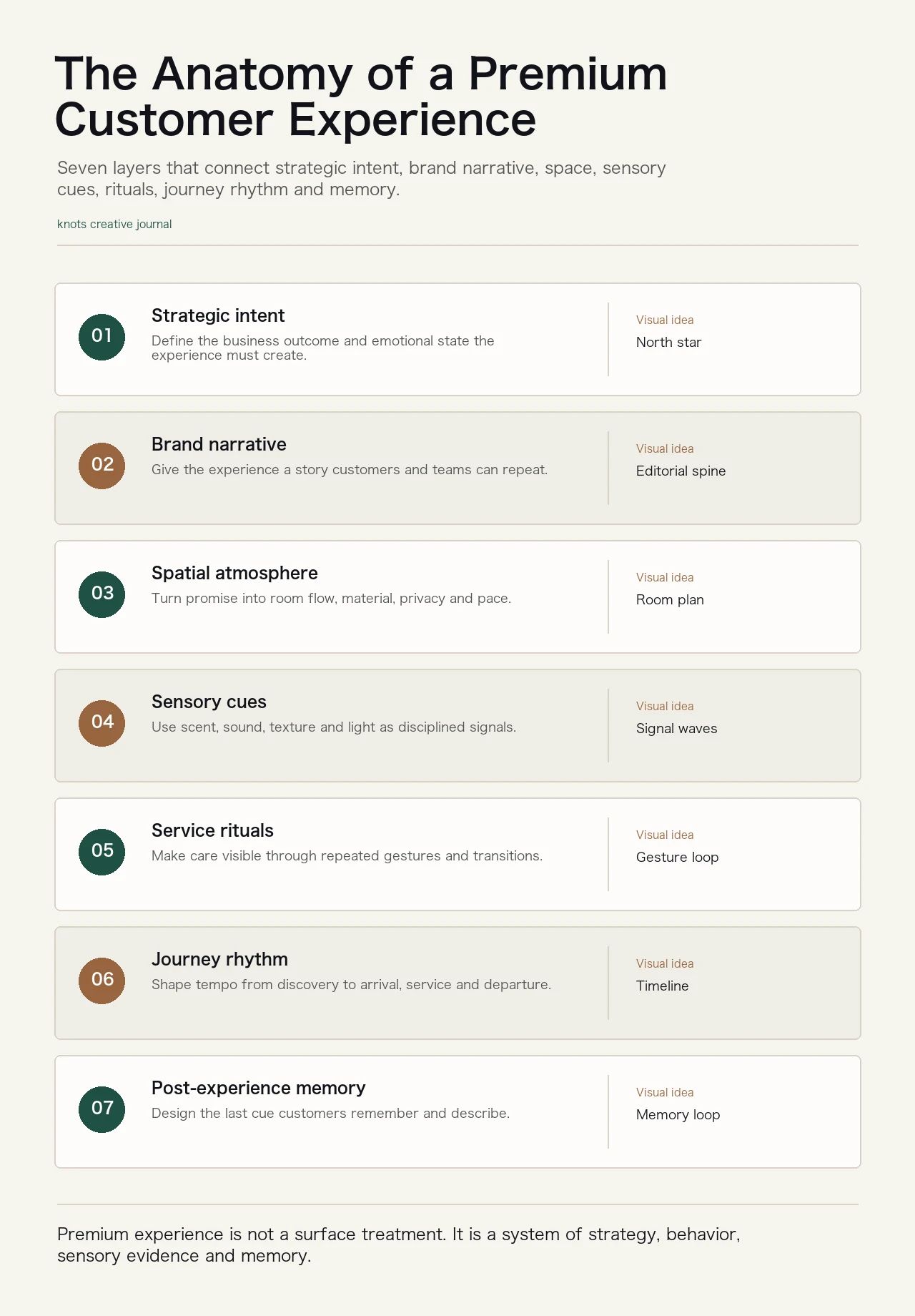
Strategic intent
Explanation: Defines the business outcome and the emotional state the experience should create.
Example: A wellness brand chooses recovery and trust as its primary promise.
Application tip: Write the experience goal before designing the room, script or campaign.
Visual idea: North star marker
Brand narrative
Explanation: Gives the experience a story customers and teams can repeat.
Example: A heritage-led spa frames treatments as rituals of renewal, not isolated services.
Application tip: Translate positioning into language used on menus, pages and staff scripts.
Visual idea: Editorial spine
Spatial atmosphere
Explanation: Turns the brand promise into a physical environment.
Example: Lighting, privacy and material choices slow the pace before consultation.
Application tip: Audit what the space makes customers feel in the first three minutes.
Visual idea: Layered room plan
Sensory cues
Explanation: Uses scent, sound, texture and pacing to create recognition.
Example: A quiet scent and warm towel mark arrival without verbal explanation.
Application tip: Choose one or two sensory signatures and make them operationally consistent.
Visual idea: Subtle signal waves
Service rituals
Explanation: Structures repeated gestures that make care visible.
Example: A guided welcome, consultation pause and closing tea create a rhythm.
Application tip: Document rituals so teams can repeat them without becoming robotic.
Visual idea: Gesture sequence
Customer journey rhythm
Explanation: Shapes the tempo from discovery to memory.
Example: Booking, arrival, treatment, payment and aftercare each have a designed pace.
Application tip: Remove rushed transitions and create buffers around high-emotion moments.
Visual idea: Journey timeline
Post-experience memory
Explanation: Designs what the customer remembers and says afterward.
Example: A simple aftercare note helps customers name the value they received.
Application tip: End with a clear memory cue, not an abrupt transaction.
Visual idea: Memory loop
Mini FAQ: service design, sensory branding and premium experience
What is service design?
Service design is the practice of planning how a service works across people, spaces, processes, tools and customer touchpoints. It looks beyond a single interface or visual identity and studies the full operating system behind an experience. In a premium service business, that may include how a guest discovers the brand, books an appointment, enters the space, receives guidance, moves through the ritual, pays, leaves and remembers the experience later. Good service design connects frontstage moments, such as greeting and consultation, with backstage systems, such as training, scheduling, handoff rules and quality control. This matters because customers rarely judge a brand from one isolated detail. They judge rhythm, clarity, emotional tone and whether the promise feels consistent. For founders and brand teams, service design provides a practical way to make experience intentional instead of accidental. It turns hospitality, wellness, retail or professional services into mapped journeys that teams can test, improve and repeat. A practical next step is to blueprint one high-value journey and separate what the customer sees from what the team must coordinate behind the scenes. This reveals training gaps, timing issues and brand moments that should become repeatable rituals.
What is sensory branding?
Sensory branding is the deliberate use of sensory cues to make a brand recognizable, memorable and emotionally coherent. It can involve scent, sound, texture, lighting, spatial temperature, taste, pacing, visual composition and even silence. The point is not to overload the customer with stimulation. The point is to decide which sensory signals support the brand promise and which signals should disappear because they create friction. A wellness brand might use quiet lighting, warm materials, slow transitions and a signature aroma to communicate recovery. A premium retail brand might use weight, packaging sound, room layout and staff movement to communicate care. Sensory branding works when it is linked to strategy. A scent chosen only because it is pleasant is decoration. A scent chosen because it marks arrival, lowers cognitive load and reinforces a ritual can become part of the customer journey. The best sensory systems are subtle, repeatable and operationally realistic. The safest starting point is a sensory audit. Walk through the space as a first-time customer and record what you hear, smell, touch, see and feel at each stage. Keep only cues that support the strategy and remove signals that create noise.
How does customer experience design help a brand?
Customer experience design helps a brand by making the promise tangible. Many companies can describe what they stand for, but customers believe the brand only when the experience proves it. If a brand claims to be calm but its booking flow is confusing, its team is rushed and its physical space is noisy, the promise collapses. Customer experience design translates positioning into moments people can feel: onboarding, consultation, waiting, service delivery, support, packaging, follow-up and memory. It also gives teams a shared language for improvement. Instead of debating vague impressions, teams can map the journey, identify friction, prioritize touchpoints and prototype better behavior. For business leaders, this creates measurable value because experience affects trust, retention, referrals, conversion and willingness to pay. A stronger experience also reduces operational ambiguity. Employees know what good looks like, managers know what to train, and customers receive a more consistent signal at every stage. For leaders, the useful exercise is to choose one promise and test whether the experience proves it. If the brand promises calm, check the booking flow, arrival, waiting, service language and follow-up. Any contradiction becomes a design brief.
Why is hospitality branding important?
Hospitality branding is important because hospitality businesses sell time, care, trust and emotional transition as much as they sell a room, treatment, meal or appointment. The brand is not limited to a logo or interior style. It appears in how people are welcomed, how waiting is handled, how staff explain choices, how the environment reduces anxiety and how the customer is returned to the outside world. In hospitality, small details carry heavy meaning because the customer is often physically present, emotionally open and sensitive to inconsistency. A warm greeting can make the brand feel generous; a confused handoff can make the same brand feel careless. Hospitality branding gives these details a system. It defines tone of voice, spatial cues, rituals, service standards, visual language and recovery moments when something goes wrong. For premium brands, hospitality branding is especially powerful because it turns service into a remembered relationship rather than a transaction. A practical hospitality-branding review should include both the guest-facing journey and the employee experience. Staff need language, permission and rituals that let them deliver care consistently, especially when the environment is busy or emotionally sensitive.
How can wellness spaces improve brand perception?
Wellness spaces can improve brand perception by creating physical evidence of care. A customer may not understand a brand strategy document, but they immediately understand whether a space makes them feel considered. Layout, scent, lighting, acoustics, privacy, material choices, consultation flow and therapist behavior all communicate the brand before any marketing claim is read. In wellness, the space also affects the body. If the arrival is rushed, the corridor is loud or instructions are unclear, the customer carries tension into the treatment. If the space slows the pace, protects privacy and makes each step legible, the customer becomes more receptive to the experience. This changes perception because the brand is felt as competent and emotionally intelligent. A well-designed wellness space also creates stronger memory. The customer does not remember every detail, but they remember the transition from pressure to calm, and that transition becomes associated with the brand. The most useful improvement is often not a large renovation. It may be clearer consultation, better arrival pacing, a quieter transition, more privacy or a stronger closing ritual. These changes make care visible and help customers name the value they received.
What makes a premium customer experience memorable?
A premium customer experience becomes memorable when it combines clarity, emotional contrast, sensory coherence and a strong ending. Clarity helps the customer understand what is happening and what to do next. Emotional contrast creates a before-and-after feeling, such as arriving stressed and leaving grounded. Sensory coherence makes the experience recognizable without needing to explain it. A strong ending gives the customer a final memory that organizes everything that came before. Premium does not necessarily mean more elaborate. Often it means more edited. The brand removes unnecessary decisions, protects the customer from awkwardness and makes the essential moments feel deliberate. Memorable experiences also have narrative shape. There is arrival, orientation, deepening, resolution and return. When a service business designs that rhythm well, customers can describe the experience to others because it has a story. That story becomes word of mouth, review language, social proof and brand equity. Brands can strengthen memory by designing one signature moment near the end of the journey. It might be a note, a ritual, a sensory cue or a simple explanation that helps the customer understand what changed and what to do next.
How do brand systems support service businesses?
Brand systems support service businesses by making consistency easier to repeat. A service business depends on people, timing and context, which means the experience can drift if the brand exists only as a mood board or logo file. A strong brand system gives teams practical rules: how to speak, what to show, how to frame choices, what visual cues to use, how to handle arrival and departure, which rituals matter, and how to recover from service failures. It also connects marketing with operations. The website, social content, signage, scripts, treatment menus, packaging and follow-up emails should feel like parts of the same system. For premium service brands, this is crucial because customers notice small contradictions. If the online identity feels refined but the in-person journey feels improvised, trust weakens. Brand systems help service businesses scale without flattening personality. They protect the core promise while giving teams enough structure to adapt to real customer situations. A service brand should treat its brand system as an operating manual, not only a design file. The system should guide scripts, signage, onboarding, content, service recovery and the small gestures that turn positioning into behavior.
How can companies design better physical and emotional touchpoints?
Companies can design better physical and emotional touchpoints by mapping the customer's state, not only the customer's actions. A journey map that lists steps is useful, but it becomes more powerful when it asks what the customer is feeling, fearing, expecting and trying to decide at each moment. Physical touchpoints include entrances, counters, chairs, forms, packaging, lighting, tools and digital screens. Emotional touchpoints include reassurance, permission, anticipation, privacy, recognition, trust and closure. The best design work connects both. For example, a consultation card is physical, but its purpose may be emotional: helping the customer feel understood. A quiet waiting area is spatial, but its strategic role may be reducing uncertainty before a premium service. Companies should prototype these moments, observe real behavior and train teams around the intended emotional outcome. Better touchpoints come from alignment between strategy, environment and behavior, not from isolated aesthetic upgrades. A useful workshop exercise is to map each touchpoint against two questions: what does the customer need to do, and what do they need to feel? The second question often reveals the design opportunity that an action-only journey map misses.
Conclusion: calm is a business design choice
The strongest premium experiences feel effortless to the customer because they are carefully structured behind the scenes. Service design gives that structure. Sensory branding gives it emotional texture. Brand systems make it repeatable. Spatial storytelling gives it physical evidence. Editorial strategy helps the memory travel beyond the visit.
For leaders, the important shift is to stop treating customer experience as a decorative layer and start treating it as a business design choice. The question is not whether the space looks premium. The question is whether every touchpoint helps the customer understand, trust and remember the brand. When that happens, calm becomes more than atmosphere. It becomes a competitive advantage.