FIND – Design Fair Asia is coming to Bangkok on 26–28 November 2026, creating a timely opportunity for brand leaders, hospitality operators and creative teams to connect physical design with business strategy. For a studio interested in transformation, the useful question is how the ideas encountered at a fair become better customer experiences, clearer positioning and practical decisions.
This preview combines verified event information with our editorial framework for making the visit useful. The event has not yet taken place; the examples below are suggested exercises, rather than reports of exhibitor results or projects delivered by knots creative.
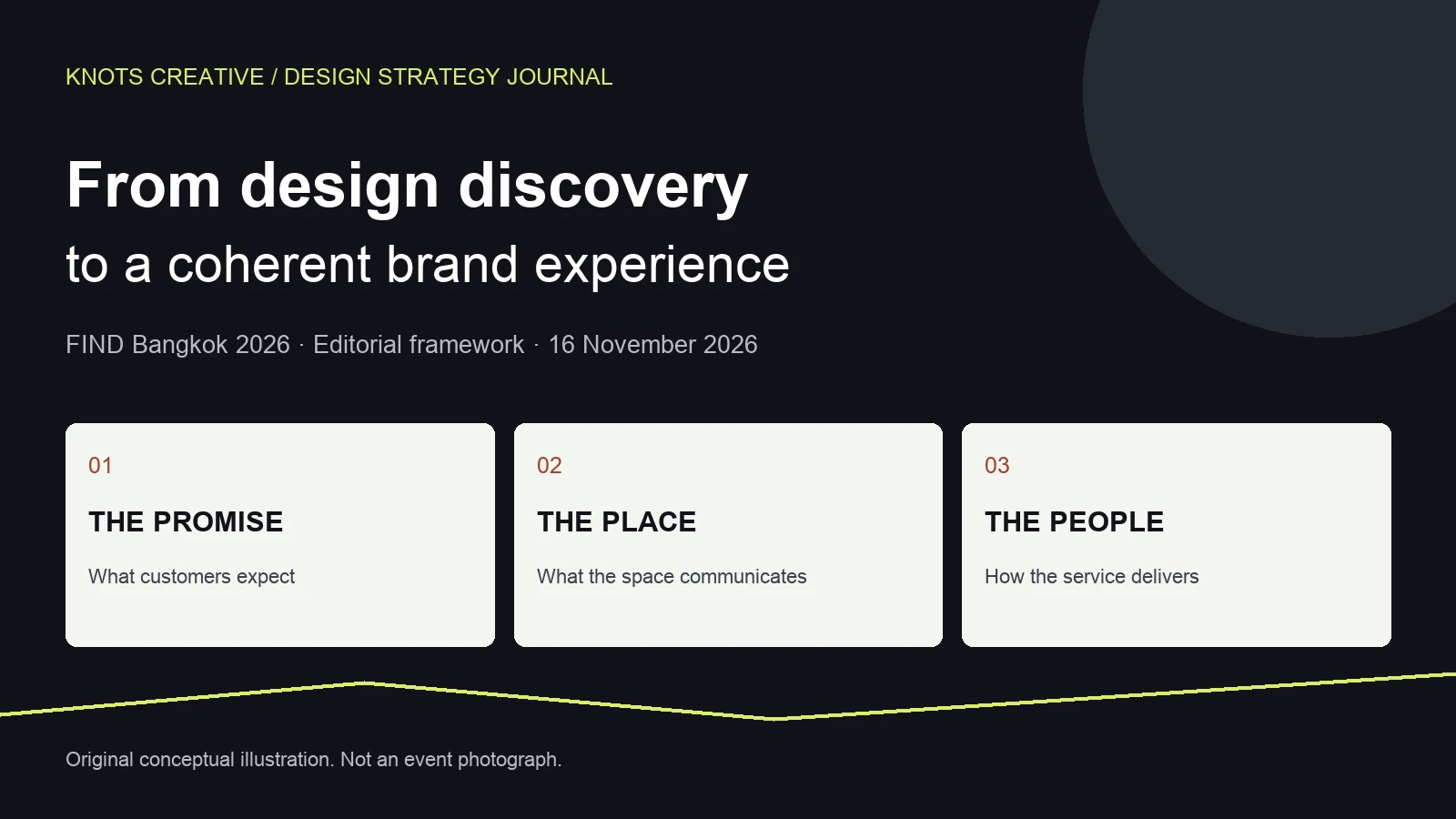
FIND Bangkok 2026: the essential details
The organiser’s visitor guide lists Hall 2 at the Queen Sirikit National Convention Center, or QSNCC, as the venue. Published opening hours are 10:00–19:30 on 26–28 November. Online preregistration is currently free, while onsite registration is listed at THB 500. The fair is for adult professionals, with a minimum visitor age of 18.
The same guide recommends the MRT Blue Line to Queen Sirikit National Convention Center Station, using Exit 3 for access to the venue. Check the live registration page and programme before travelling, because arrangements and individual sessions can change.
FIND’s Bangkok debut is also confirmed by the Thai-Italian Chamber of Commerce’s October announcement. Its audience includes designers, developers, hospitality groups, distributors and buyers. That mix makes the fair relevant to people responsible for the whole customer experience, as well as those selecting furniture or finishes.
Why a design fair belongs in a brand strategy conversation
A brand promise becomes credible through details that customers can experience. A hotel may describe itself as restorative, yet its arrival process, acoustics and lighting might communicate urgency. A retail brand may promise thoughtful service while presenting a confusing sequence of choices. These contradictions are design problems with strategic consequences.
Our guide to design strategy for business transformation explains the importance of making a decision explicit before choosing creative outputs. Apply that principle to a fair visit: define the customer problem first, then look for materials, partnerships and operating ideas that could help solve it.
The opportunity is to connect disciplines that often work separately. Brand teams can discuss recognition with interior designers; operations teams can explain maintenance and training constraints; founders can test whether an attractive idea supports their actual positioning. That conversation is more useful when everyone works from the same customer journey.
Three design signals worth investigating
The official FIND Global Summit overview groups its programme around Asian design leadership, a new vernacular, and sensory sanctuaries. The following questions are our interpretation of those themes for brand and service teams, rather than predictions about what individual speakers will announce.
1. Local authorship as a source of distinctiveness
Ask how a material, production method or spatial decision reflects a particular place. A locally informed identity should have a story that staff can explain and customers can understand. Collect evidence about the maker and process, then consider whether that story belongs in the experience. Avoid reducing cultural references to decorative motifs detached from their context.
2. Circularity as an operational question
The programme includes adaptive reuse and circularity. Use those topics to investigate repair, replacement and long-term care. Before recommending a surface or furnishing, ask what happens when it is damaged, who services it locally and which supporting documentation exists. Record suppliers’ claims as claims until verified. A credible brand narrative needs practical evidence behind its environmental language.
3. Sensory experience across the whole journey
The hospitality and wellness focus connects naturally with service design and sensory branding. Evaluate how an idea changes the transition from arrival to orientation, service and departure. A beautiful waiting chair matters differently if it improves comfort, protects privacy or supports a better consultation. Link the object to a customer need before treating it as a brand asset.
Watch the organiser’s Bangkok edition preview
The following promotional video is published by FIND – Design Fair Asia. It introduces the 2026 Bangkok edition; it is not footage documenting the upcoming November event.
Watch the official preview on YouTube if the embedded player is unavailable.
Build a research plan before entering the hall
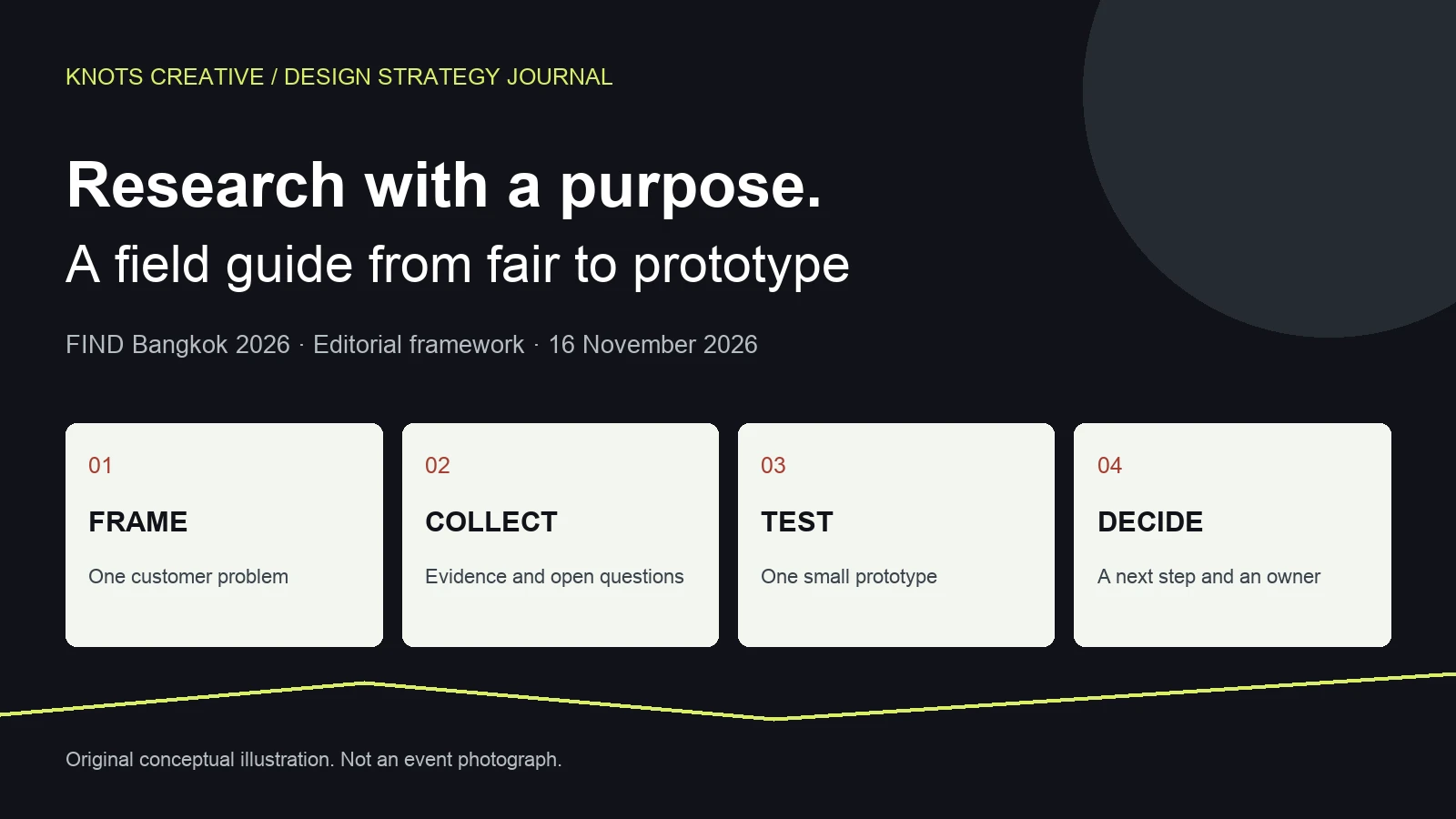
Choose one live problem and write a short brief. For example: “How could our reception help first-time guests feel oriented within two minutes?” Bring a simple journey map, the current brand promise and the operational limits. Set up conversations around these inputs instead of collecting unrelated references.
For each relevant encounter, record four things: the customer need, the proposed response, the evidence available and the unresolved question. A supplier conversation might reveal a useful acoustic treatment, but the open questions could include installation, cleaning and performance in your particular space. Photograph samples only with permission and keep contact details beside the observation.
For a small team, divide responsibilities between customer experience, brand expression and feasibility. Reunite after a few visits to compare findings. This approach borrows from co-creation workshops that turn insight into decisions: people need a shared question and a way to resolve competing interpretations.
Turn fair observations into a small prototype
Within a week, select one improvement you can test without a full redesign. A hospitality team could combine a revised greeting, a clearer menu and a seating adjustment into a reception walkthrough. A retail team could test how lighting and product information affect understanding. These are illustrative exercises, with outcomes still to be observed.
Use the discipline described in service design prototyping before building. Define the assumption, run the test with representative users and observe behaviour. Can people identify the next step? Do staff explain the offer consistently? Where do customers hesitate? Compare findings with the original experience before committing to larger spending.
Close the review with a one-page decision: what was learned, what remains uncertain, what will change and who owns the next action. Keep useful references in a reusable library connected to your brand system. The fair’s value can then extend into everyday decisions long after the exhibition closes.
Measure learning before counting contacts
Agree on a few useful outcomes before the team returns to work. Count the assumptions clarified, the supplier claims that still need verification and the ideas ready for testing. Keep the list short enough to review together. A crowded contact sheet is difficult to act on if nobody knows which conversation addresses the original brief.
After the prototype, record what customers actually understood and what staff could deliver consistently. Those observations help separate a promising direction from a visually appealing reference. They also make the next brief more precise: the team can explain the behaviour it wants to change, the constraints it discovered and the evidence required before investing further.
A wider Bangkok design moment
Another event, THE WORLD ENDS: Bangkok International Design Expo 2026, is scheduled for 25–29 November at Bangkok Kunsthalle. A 3 November article written by TCEB and published by UFI describes its emphasis on dialogue, networking and business connections. It is a separate event at a separate venue; verify its own programme if combining visits.
Frequently asked questions
When and where is FIND Design Fair Asia 2026?
It is scheduled for 26–28 November 2026 at QSNCC in Bangkok. The organiser’s visitor guide lists Hall 2 and opening hours of 10:00–19:30.
Is admission free?
The organiser currently offers free online preregistration and lists onsite registration at THB 500. Confirm current terms before attending; visitors must be at least 18.
How can a brand team make the visit useful?
Bring one customer problem, document evidence and unanswered questions, then test one practical change. Assign an owner so the research leads to a decision.
For teams connecting positioning, service and physical touchpoints, discuss a design strategy brief with knots creative.
Sources checked on 16 November 2026. Event facts are attributed above; the research framework and examples are knots creative editorial analysis. No affiliation with FIND or its exhibitors is implied.